We are very pleased to be able to announce that Antonia Seymour, CEO of IOP Publishing, who was recently elected President of the Publishers Association, will be one of the keynote speakers for the Researcher to Reader Conference, which takes place on 20 and 21 February 2024.
Antonia Seymour is a highly experienced science, health, technical and professional publisher, who has held senior roles at Blackwell and Wiley, and became CEO of IoP Publishing in 2021. She has also served on the Board of International Association of STM Publishers.
R2R will return to including a two-keynote format for 2024, following a pause during the online and hybrid events of 2020-2023. We very much look forward to Antonia Seymour’s participation in the Programme.
The 2024 Conference Call for Papers is open until the end of August, and the guidance and a link to the proposal creation platform is on the Call for Papers page of the website. The R2R Conference will be held in London on 20-21 February 2024, and registrations will open in October.
Researcher to Reader is delighted to be partnering with Ex Ordo for proposal management for the Call for Papers (C4P) for the 2024 Conference.
“Our Call for Papers is a very important part of the development of our conference programme,” said R2R Conference Director Mark Carden. “We were looking for a way to streamline our processes, and had three key criteria: people who understand academia, people who build great software, and people we like and trust. Ex Ordo delivered on all three so outstandingly well that it was just a very easy and natural choice for us.”
Paul Killoran, Ex Ordo founder and CEO said, “Organising a conference is logistically very challenging, and we’re proud knowing that the simplification offered by our platform is going to help the R2R team spend more time crafting a richer programme; something that will benefit our entire community.”
The call for papers is open until the end of August and the guidance and a link to the proposal creation platform is on theCall for Papers page of the website. The Conference will be held in London on 20-21 February 2024, and registrations will open in October.
We are delighted to announce that Digital Science has returned as a sponsor of the Researcher to Reader Conference, becoming a Silver Sponsor for the 2024 event.
Digital Science is an innovative technology company offering digital solutions across the research ecosystem. In partnership with researchers, universities, funders, industry and publishers, Digital Science works towards advancing global research for the benefit of society. The Digital Science brands – Altmetric, Dimensions, Dimensions Research Integrity, Figshare, ReadCube, Symplectic, IFI CLAIMS Patent Services, Overleaf, Writefull, OntoChem, Scismic and metaphacts – help to solve problems and drive progress for all.
R2R is grateful for the renewed support from Digital Science – our sponsors help to make the Conference affordable for all members of the scholarly communications community.
The Call for Papers is currently open for the upcoming Conference, which will take place in London on 20-21 February 2024. Registration will open in October.
Researcher to Reader has announced that the Call for Papers for the 2024 Conference will be open throughout July and August 2023. The Conference will take place in London on 20–21 February 2024.
The key Call for Papers headlines are:
The proposals that the scholarly community makes are a key contributor to R2R programme development.
Conference formats may include: Presentation, Panel, Workshop, Interview, Debate or Lightning Talk.
Anyone involved in scholarly communications can be a contributor to the programme.
Any topic relevant to people working across scholarly communications is of interest.
Some ‘provocations’ to get people thinking about topics are provided in the R2R Community Forum.
Proposals should be made by the deadline of 31 August; earlier and higher-quality proposals generally have a higher acceptance rate.
Contributors should plan to join the Conference physically at the venue if possible, but can be online if necessary, and should ideally aim to participate in the whole Conference, not just ‘fly in’ to address an audience.
Accepted contributors (except for Lightning Talks) have discounted or free registration.
We have no overall theme for the 2024 Conference, as we find that too limiting. We particularly value topics that are of broad interest across the diverse range of people and organisations that participate in scholarly communication, rather than subjects that focus on one particular silo. Our delegates are primarily interested in the interactions between the various parts of the scholarly communications supply chain, and how different people and organisations can work together more effectively. The Conference also values topics that are practical, informative or supported by evidence – we are interested in facilitating what could be done, rather than merely evangelising about what should be done. There are some ‘provocations’ to encourage creative proposals in the R2R Community Forum, where discussion around these and other topics is encouraged.
This year R2R will be using the Ex Ordo system for supporting the preparation and evaluation of proposals. A link to the proposals platform is provided here and on the Conference website, to allow contributors to create an account and then prepare a proposal online.
More information and guidelines about the Call for Papers process is given on the R2R Website.
The 2023 Researcher to Reader Conference has been highlighted by our AV production partner Giggabox as a case study in effective hybrid event delivery. The case study illustrates how Giggabox supported R2R on 21 & 22 February, bringing our online & physical contributors and participants together in a high-quality hybrid environment, and earning 100% positive ratings in our delegate feedback survey.
We are delighted to announce that the Royal Society of Chemistry has once again renewed their Gold Sponsorship of the Researcher to Reader Conference. With the 2024 Conference still over 11 months away, this early renewal by RSC is a a great vote of confidence in the Conference and its enthusiastic support for sponsors. By sponsoring at this stage, RSC secures its Gold position, gives the Conference an early boost, and also maximises the exposure that the the Society gets from its involvement with Researcher to Reader over the coming year.
The Royal Society of Chemistry is an international organisation connecting chemical scientists with each other, with other scientists, and with society as a whole. Founded in 1841, the RSC has an international membership. The RSC uses the surplus from their global publishing and knowledge business to give thousands of chemical scientists the support and resources required to make vital advances in chemical knowledge. The RSC is a catalyst for the chemistry that enriches our world.
The 2024 Conference will be on Tuesday 20 and Wednesday 21 February 2024 and the Call for Papers will be launched in July.
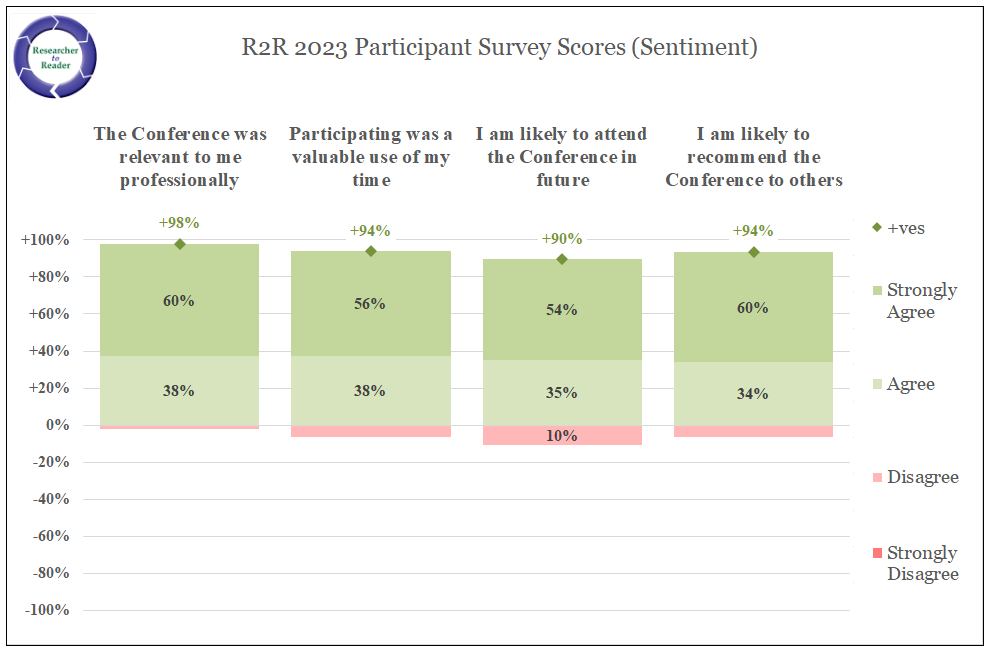
Participant feedback for the 2023 Researcher to Reader Conference, delivered in a hybrid format on 21-22 February, shows continued high levels of satisfaction with the event, with delegates rating the Conference very positively. Of those responding to the survey, 94% to 98% rated the Conference relevant, valuable and recommendable, with the content overall receiving 89% positive ratings. The plenary sessions received average scores ranging from 3.0 to 3.5 (out of 4) and the lightning talks averaged 3.2 overall. The majority of the workshops received 100% positive feedback, with an average score of 3.7. The event administration got 96% positive feedback and the AV an impressive 100% from both physical and online participants. More details are given below.
The survey, completed by 60 out of about 200 participants, showed over 98% of respondents agreeing that the Conference was relevantto them professionally, and 94% saying it was valuable use of their time and that they would recommend it to others. Just three respondents said that R2R was not valuable to them, although two of these did describe their workshops as ‘brilliant’ and ‘excellent’, and rated several sessions as ‘great’.
The plenary sessions at the Conference (including panels, presentations and the debate) also received a highly positive response across the board. All sessions received an average rating of 3.0 to 3.5 (out of 4). This consistent range of high scores shows that the vigorous curation of the programme is highly effective in ensuring all sessions are of high quality, and are valued by the vast majority of participants. Five of the plenary sessions were rated as ‘Great’ by over half of the respondents, with particular highlights being the debate (with 66% of respondents rating this as ‘Great’) and the panel on the future of OA funding (with 92% of respondents rating this positively).
The hybrid interactive workshops were also all highly rated, receiving an average rating of 3.3 to 3.9 (with around 5-10 responses for each of these breakout sessions). Almost everybody rated their workshop ‘Good’ or ‘Great’. The session providing feedback from all the workshops, given to the whole Conference, was viewed positively by 100% of respondents.
The lightning talk sessions also received generally positive feedback, with average scores ranging from 3.1 to 3.4 (based on around 10-15 responses for each talk given by those who actively chose to attend these optional sessions). The lightning talks are proving to be consistently (and increasingly) popular, even though some are purely commercial presentations.
The overall content and structure of the Conference was positively reviewed, with almost all respondents giving very positive scores and comments on the content of the sessions. Confusingly, a few people commented R2R was too ‘publisher-centric’, while others said that there was not enough content relevant to publishers. We aim to offer topics covering the whole scholarly communications ecosystem, as content is passed from the researcher to the reader, but this does mean we can seem a bit too ‘broad’ for some people.
The format and timetable for the Conference was also positively reviewed by over 70% of respondents, although there was some dissatisfaction with the pace of the event (with some people reporting that the breaks or the sessions were too long, and others that they were too short). Our shift to a later start and finish and to a two-break structure (partly to cater to the time-zone needs of US-based online participants) was questioned, or actively disliked, by several people. Our increased proportion of panels over presentations (partly driven by a desire to offer a highly interactive experience for online participants) was disliked by a few respondents, while others valued the interactivity. Several respondents suggested that the lightning talks should be part of the plenary programme, not running during the breaks, although it would be challenging to find time to schedule this, and some people might dislike ‘non-optional’ commercial presentations. Encouragingly, several people suggested that the problem was an excess of good content, and that we should move to a 3-day event. We will review the format and timetable for future events in the light of this feedback.
The online platforms – the digital venue (Eventscase) and the virtual rooms (SpatialChat) – got generally positive reviews, but the use of the virtual rooms to deliver hybrid lightning talks (aimed at making this easier for online participants) was not satisfactory for many physical participants – although the talks themselves went well – and a few people reported having problems using the online resources. Several physical participants were disgruntled at being encouraged to use the digital platform for text chat. The audio-visual presentation, managed by our partners Giggabox, received 100% positive reviews from both online and physical participants.
The event administration, managed by The Events Hub, got 96% positive scores, and only a handful of people now say that they get too many emails, almost balanced by people saying that our marketing communications are ‘just right’. Several people thought the print programmes (and the R2R jigsaw puzzles) were unnecessary and unsustainable, but many others were very keen on them. We recycled about 60 programmes after the event; in future we will probably continue to print a programme, but in smaller quantities and without posting them to delegates. Our remaining stock of cardboard jigsaw puzzles (printed in Latvia on sustainably-sourced card) will continue to make their appearance in future, but we may have to recycle some in the end.
The venue and catering (BMA House) got many positive comments during the event and in the feedback survey.
The feedback on the hybrid nature of R2R was vary varied, although most online people were impressed with the experience, and many online and physical participants were strongly supportive of hybrid. We were disappointed that no online participants took the opportunity to join the plenary Q&As live on screen, but many of them were very active in the hybrid workshops. All of the online respondents agreed that the Conference was relevant, valuable and recommendable, and on average they rated almost every aspect of the event slightly more positively than the physical participants. Several respondents were, however, very committed to a physical meeting experience, including some online participants who say that they plan to be physically at the venue next time, and some people were critical of the scheduling, platform and cost compromises necessitated by hybrid. Running a hybrid event is challenging and expensive, and certainly risks making things a little harder for physical participants, and for moderators and facilitators. We will have to carefully consider the viability and processes for hybrid in future.
Many of the comments in the survey were very positive, both about individual sessions and the event as a whole. Participants said:
Interesting discussions; lively speakers
Very relevant to me
Engaging and thought-provoking
The subjects covered were good
Always fun and informative
All the sessions were fantastic
The conference was excellent
I really love how interactive it is
The workshops were brilliant
Networking opportunities are excellent
Excellent mix of attendees especially from US
Great for networking
Very good conference, quality of the hybrid experience a real strength
The hybrid option worked well and online participants were visible
Excellent hybrid experience/platform, congratulations to those responsible
I’m really impressed how well the hybrid format worked and think it’s very innovative
Administration very friendly and helpful
Registration was excellent as was all the pre-conference support
The organisation was brilliant
Good marketing communications
Good value, fair pricing
The venue and catering were amazing
Loved the vegan food!
Excellent venue
Overall the survey results (and other feedback) suggest that 2023 Researcher to Reader Conference was informative and enjoyable for the vast majority of participants. We are reviewing all the feedback carefully to see what improvements can be made in future.
Registrations are at their highest ever level for the Researcher to Reader Conference, taking place as a hybrid meeting in London and online on 21-22 February 2023. The end-of-January total was higher than in any of the previous 7 years of the event, and new registrations are still coming in.
For past Conferences, anywhere from 10 to 50 additional people register during February, with some people just turning up on the day, so registrations remain open for people who want to join this meeting at the physical venue or online. This year’s Programme is available on the website, along with Registration information.
Mark Carden 6 February 2023 (typo corrected 8 Feb)
The 2023 Researcher to Reader Conference, which will take place as a hybrid event in London and Online on 21-22 February, will include several ‘Lightning Talks’. These are short presentations given by Conference delegates during the breaks in the main programme. The planned Lightning Talks are likely to include the following:
Streamlining Routes from Discovery to Access – Hylke Koers ♦ Chief Information Officer at STM
Publishing XML – The First Step Towards Openness – Dr Kaveh Bazargan ♦ Director at River Valley Technologies
Streamline Submission Checklists Using Process Automation – Andrew Walker ♦ Director at TaskAdept
Author Services – Kurtis Jackson ♦ Head of English Editing at MDPI
Supporting Authors to Succeed – Hazel Newton ♦ Director, Research Solutions at Springer Nature
The Multi-Faceted Researcher/Reader – Zoe Wake Hyde ♦ Communty Development Manager at HCommons
Strengthening Scientific Integrity Through a Cross-stakeholder Approach – Dr Leslie McIntosh ♦ CEO at Ripeta
What Scholcomm Professionals Need To Know – Will Cross ♦ Director of the Open Knowledge Center at North Carolina State University
Publishing Partnerships: Shared Values, Shared Success – Robyn Mugridge ♦ Head of Publishing Partnerships at Frontiers
Unmasking the Secret Life of Reviewers – Alice Ellingham ♦ Director at Editorial Office
Embracing and Accelerating an Open Access Future – Hannah Barnsley ♦ Strategic Programme Manager at the Royal Society of Chemistry
Solving Editorial Challenges with the Aries Ecosystem of Connected Tools – Jason De Boer ♦ Business Development and Partnerships Manager at Aries Systems
AI-Driven Search Engines for Scholarly Literature – Marydee Ojala ♦ Editor at Information Today
More information will be available in the complete downloadable Conference programme, which will be published via the Programme page of the Conference website next week.
Registrations for the 2023 R2R Conference are currently open, with generous discounts available for librarians, academics and concessions.
We are very happy to be able to announce that Editorial Office has returned as a Researcher to Reader Conferencesponsor at the Bronze level. R2R is a fully-live hybrid meeting taking place in London and Online on 21-22 February 2023.
Editorial Office has grown significantly over 20 years, always adapting in line with the latest development of peer review and submissions systems. They are passionate about future-proofing their role in the publishing sector, working to help publishers, of all kinds, as they continue to improve and streamline processes, using cutting-edge automated software.
Registrationis open for Conference, which is a fully-hybrid event allowing live participation for both physical and online delegates. And the full Programme is available on the website.









 Researcher to Reader Conference — London — 24-25 February 2026
You must be logged in to post a comment.