We are delighted to announce that MDPI has renewed their Silver Sponsorship of the Researcher to Reader Conference for the 2026 event, taking place in London on 24-25 February. R2R is grateful for their continuing support for our scholarly communications conversations, and is confident that is is a powerful marketing opportunity for MDPI.
MDPI is a pioneer in scholarly, open access publishing, that has supported academic communities since 1996. Based in Basel, Switzerland, MDPI has the mission to foster open scientific exchange in all forms, across all disciplines. MDPI’s 496 diverse, peer-reviewed, open access journals are supported by more than 115,000 academic experts who support MDPI’s mission, values, and commitment to providing high-quality service for our authors. MDPI’s articles are freely available and distributed under a Creative Commons Attribution License.
Our sponsors provide invaluable support for the Conference, helping us to keep our registration prices lower. Registration is open, with exceptional discounts available for academics, librarians and concessions. R2R currently has a record number of participants signed up for the February meeting. The full Programme and timetable has been announced.
R2R is delighted to announce that Cassyni has become a first-time sponsor of the Researcher to Reader Conference at the Bronze level. Cassyni will also be hosting the recordings of our R2R 2026 sessions. We are very grateful for their financial and practical support.
Cassyni is the leading platform for research seminars that brings research to life through AI-enhanced video experiences. Used by leading publishers and institutions, Cassyni helps journals boost visibility, engagement, and citations — building vibrant research communities, deepening researcher engagement, and driving submissions through what’s become known as the “Cassyni Effect”.
The 2026 Researcher to Reader Conference will take place on 24-25 February in London. Registration is open, and the full Programme is now available.
R2R is very pleased to be able to announce that Silverchair has returned as a sponsor of the Researcher to Reader Conference, and we are very grateful for their support.
Silverchair is the leading independent platform partner for scholarly and professional publishers, serving its growing community through flexible technology and unparalleled services. Silverchair’s teams build, maintain, and innovate platforms across the publishing lifecycle — from idea to impact. Silverchair products facilitate submission, peer review, hosting, dissemination, and impact measurement, enabling researchers and professionals to maximize their contributions to our world.
The 2026 Researcher to Reader Conference will take place on 24-25 February in London. Registration is open, and the full Programme is now available.
R2R is delighted to announce that Digital Science has returned as a sponsor of the Researcher to Reader Conference, once again taking up a Bronze Sponsorship. We are very grateful for their support.
Digital Science is an AI-focused technology company providing innovative solutions to complex challenges faced by researchers, universities, funders, industry and publishers. Their products – including Altmetric, Dimensions, Figshare, and Overleaf – help publishers to analyze data more effectively, track research outcomes, safeguard research integrity, enhance author services, and identify collaborators.
The Conference will take place on 24-25 February 2026 in London. Registrationis open, and the Programme is available on the website.
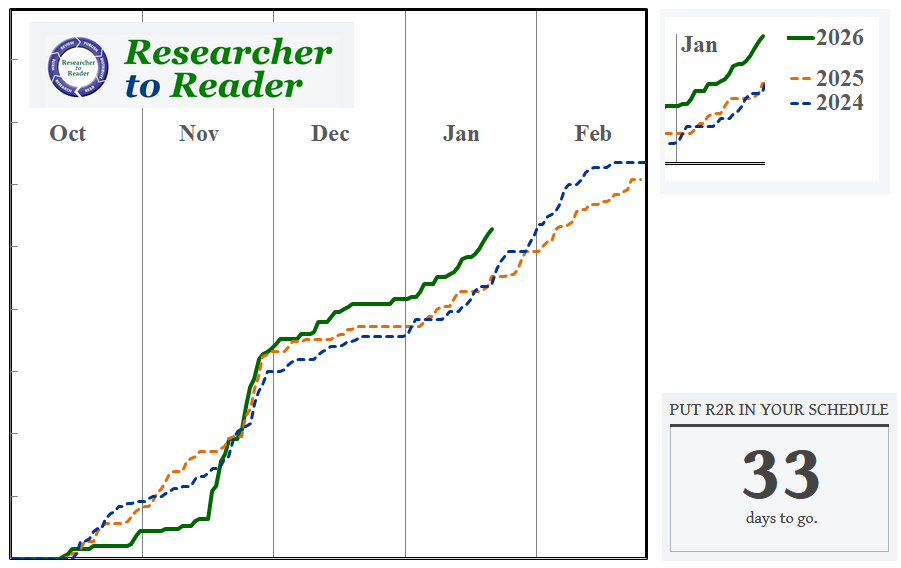
Registration for the 2026 Researcher to Reader Conference, which will take place in London on 24-25 February, has opened on 13 October 2025.
R2R will, yet again, be offering a lively and interactive two-day in-person meeting, with around 200 people from across the sector working together to improve how scholarly content gets from the Researcher to the Reader. R2R has its usual outstanding programme, and some new price concessions especially to encourage even more participation by academics and librarians.
Programme
Following an incredibly strong response to the Call for Papers over the summer, and the commissioning of some exceptional additional sessions, the key topics to be covered will include Artificial Intelligence, Peer Review and Research Integrity, with new and valuable insights for these important, but well covered, subjects.
The conference will formally debate the key concerns in Artificial Intelligence, focussing on specific pros and cons, will also facilitate discussions about the real impact of AI for authors, readers and developing countries.
R2R will also explore and discuss new Peer Review approaches outside the traditional models, frameworks and incentives.
The meeting will ask why managing Research Integrity seems to come at the end of the scholarly lifecycle, as a publisher responsibility, rather than earlier in the process within the academy’s ethical and incentive frameworks, and will explore what editors can do to pre-empt problems ‘upstream’.
Plus, there will be discussions about books, open research / open science, non-author contributors, non-journal publications, and much more. I’m not sure how we will fit it all into two days, but we will try! Somehow, there will also be plenty of time for conversations with colleagues from across the whole scholarly communications community.
The programme development for the Conference is almost complete, and more information will be given on the R2R website during October and November.
Registration Rates
R2R is already a good value event for two very full days of content, but the event works particularly hard to make it affordable for people in academic institutions, and for those early in their careers, both representing vital voices in the meeting. To continue to grow its reputation for inclusive and informed conversations, R2R is making four highly attractive offers for R2R 2026:
Significant academic discounts (up to 85% off) to make tickets highly affordable for anyone who works in a university or other academic organisation.
Some completely free tickets for UK academic library leaders, who have not attended R2R before, as they have been historically under-represented in previous meetings.
The usual ‘early-bird’ discounts, available until the end of November to all delegates, but especially attractive to budget-conscious registrants.
An ‘academic partner’ free ticket; to be issued to each of the first 50 Regular or Returning registrants (early-bird or standard rate), for them to give to a person who works in a university or other academic organisation, who has not attended R2R before.
Plus, there are discounts for returning registrants, and concessions for small companies and low-wage economies. Even people who don’t meet any of the special discount criteria can still get an ‘early-bird’ discount and a free ticket to give away. And, all tickets are fully refundable until the end of January, so there is no reason to wait.
Registration
Delegates can find complete registration details and a link to the registration platform (powered by Eventscase) on the Registrationpage of the R2R website.
Participant feedback for the 2025 Researcher to Reader Conference, which took place at BMA House in London on 25-26 February, once again demonstrated continued high levels of satisfaction with the event, with delegates rating the Conference very positively.
Of those responding to the survey (with about a 50% response rate),100% rated the Conference ‘Relevant’, while 99% rated it ‘Valuable’.
The overall event content, structure and administration continues to be highly rated, although scores for the food and the AV production dipped a little, compared with last year.
Plenary sessions in the main hall had average scores ranging from 2.9 to 3.5 (out of 4), with an overall average score of 3.2. This represents a very small reduction in scores from 2024 (3.1 to 3.7), encouraging us to curate next year’s programme even more vigorously.
Four out of the five breakout workshops received 100% positive feedback, with the average score for each of the five workshops ranging from 3.3 to 3.9 (out of 4), and an average score overall of 3.6. The lightning talks scored even better, with about the same range, but an average of 3.4 overall.
The structure of the event (timetable, mix of sessions, etc) was positively scored (92%), the food was highly regarded (95% positive), and the event administration got 96% positive feedback.
Detailed Report
Sentiment
The survey, completed by over 50% of participants, showed 98% of respondents agreeing that the Conference was Relevant to them professionally, and 100% saying it was Valuable use of their time. 98% of those responding said they would recommend the event to others – we hope they will do so!
Content and Format
The overall content of the Conference was positively reviewed, with almost all respondents giving very positive scores and comments on the scope, content and delivery of the sessions. A few people suggested we should give more attention to the humanities and to books, and we will definitely aim to improve on this. Including more funder voices was also mentioned, and we would welcome any funders who wanted to join our conversations. We also continue to strive to include more voices (on the platform and amongst the participants) from outside Europe and North America, and would welcome ideas and proposals that would help with this.
The overall format and timetable for the Conference was positively reviewed by nearly 90% of respondents. We pack a lot into two days, and some people say that they find the timetable a bit intense, but others seemed to like the energy this generates. Quite a lot of people said that they thought the days were too long, and also suggested shortening the sessions and the breaks, or even extending the meeting over 3 days. But others really value the longer conversations and networking time and want to keep all the content crammed into two days. Many people (rightly) said that starting the second workshop at 5pm was too late.
Numerous people were unhappy that we schedule the lightning talks during the breaks, but others really value not being expected to network for all the breaks. We are keen to keep commercial presentations optional for the delegates, which means not scheduling them in the plenary timetable. It is also hard to see how we could integrate about 90 minutes of this material into the main programme without extending the duration. Video recordings of the lighting talks were made available after the Conference, so that people who wanted to focus on conversations with fellow participants on the day don’t have to miss out on this content.
Some comments on the format included: “As always, nice balance of sessions and networking.” “Honestly it looked bonkers on the programme, but it was really well paced.” “Some of the sessions could be shorter and more dynamic.” “The breaks could be shorter to condense the time.” “The schedule is always jam packed but it’s good, so hard to suggest any less.” “Perfect ratio of sessions, workshops and networking.” “I enjoyed the structure of the event as a whole.” “Great variety of topics and formats.” “I like the variety of formats and the way they are made explicit.” “Having a workshop track and then plenary sessions is really nice.” “The first day was too long!” “Shorter 2nd day.” “Plenty of time to network.” “More space between the sessions for moving around.” “Perhaps less time spent on workshops?” “More time for workshops with the opportunity to participate in more than one.” “I think that the lunch break should be completely free of lightning talks.” “Talks over lunch gave a chance to eat and listen rather than network which was restful!” “Great to be able to do lightening talks OR break or both.”
Plenary Sessions
The plenary sessions at the Conference (including panels, presentations, round-tables and the debate) received highly positive ratings across the whole timetable. All sessions received an average rating of 2.9 to 3.5 (out of 4) with an overall average of 3.2. This consistent range of high scores shows that the vigorous curation of the programme is highly effective in ensuring all sessions are of high quality, and are valued by the vast majority of participants. Particularly highly rated were the Opening Keynote, the discussions on Policy & Practice, Trust Indicators and Open Science, and the presentation on Research Integrity.
Some of the comments about the sessions included concern about an excessive focus on STEM and journals, and a lack of attention to humanities and books. Several people expressed their appreciation for not having loads of AI content, but there was a feeling that we over-emphasised integrity. Several people asked for more librarians and funders on the platform, and more people from under-represented demographics and geographies; we would very much like to make that happen.
Below is a sample of the comments on the sessions overall: “Really good speakers.” “The speakers and different content styles were all very engaging.” “High quality but quite samey.” “A bit of repetition on research integrity.” “Plenty of relevant sessions – interesting.” “Good mix of trending topics with less discussed yet important ones.” “I was glad the conference avoided going too heavy on AI.” “Need more on AI technologies.” “I felt the sessions could have asked much harder hitting questions.” “There were some really interesting new perspectives this year.” “I really enjoyed the topics and the speakers.”
Workshops
The highly interactive workshops were also all positively viewed, receiving an average rating of 3.1 to 3.8 (out of 4), slightly down on the 2024 figures, but still very positive. Workshop A (Peer Review) was viewed particularly positively, with 92% respondents saying it was ‘Great’. Additionally, Workshops E (Global South) and C (Research Integrity) were considered ‘Great’ by well over half their respondents).
Overall, about 80-90% of participants rated their workshop positively, demonstrating a consistent high standard. Just three people (out of 71) rated their workshop ‘Poor’.
As in previous years, some people said that we did not allow enough time for their workshop topic, while others said they wanted to attend multiple shorter workshops, so perhaps we have the balance about right!
Comments in the feedback show great enthusiasm for well-planned and well-run workshops, with about 30 people writing very positive comments, with a small selection here: “Well facilitated and a good energy across the group.” “Loved the format – really energetic and participatory!” “It was very interactive and very well structured, and I enjoyed it.” “Great workshop, bringing together people from all over the industry.” “Very interesting and interactive, learnt a lot!” “It was an interesting topic, and the moderators led it brilliantly.” “Really enjoyed. Felt like I was doing something useful.” “It was a great session, and I really appreciated how inclusive it was.” “There was high participation, honesty, knowledge sharing and lessons.” “Enthusiastic participation and varied perspectives.”
The R2R workshops are the most demanding part of our programme, both for the facilitators and the event management, but they are highly rewarding for the participants (and, usually, for the facilitators as well); we particularly welcome proposals for workshops in our Call for Papers.
Lightning Talks
The lightning talk sessions also received generally positive feedback, with the vast majority getting scores of 3.1 to 3.5 (out of 4). The lightning talks are proving to be consistently (and increasingly) popular, even though some are purely commercial presentations.
The top-rated lightning talks included Charles Watkinson’s session on Open Access Usage Data Sharing and Joris van Rossum’s talk on Peer Review Terminology (presented in the end by Hylke Koers).
Event Overall
The ratings for the audio-visual production dropped significantly this year. With our hybrid events in 2022 and 2023, we spent a lot of money on an external AV team to ensure that the online and physical participants had a great experience. This was not really affordable for a physical-only event, however, and for 2024 and 2025 we reduced our investment in production. Despite this, the AV production went well in 2024, but we had some significant problems with the live production and the recordings this year, which we will try hard not to repeat in future. “Despite a couple of hiccups with audio and online presenters, overall good.” “Quite hard to see slides as room too light.” “Sound guys had a nightmare – non-working mics, sudden massive feedback.” “There was a problem with a remote speaker being unable to join.” “Obvious issues with sound/online joiners.”
The Conference venue got many positive comments during the event, and the catering received 87% positive ratings in the feedback survey, although this is a little bit down from last year’s 95%. We might make the food a little less spicy next time (but still flavoursome). Most people with special dietary needs seemed to be very satisfied. Comments included: “Delicious food, as always.” “The food was truly awful.” “Great choice and quality of food.” “Way better than usual conference food.” “Too many curry options.” “Amazing service catering for food allergies!”
The overall dates and duration for the event received 98% positive responses, with people generally liking the format of two full days, and people seemed happy with the slightly earlier finish on the second day. Several people said the programme is too intense or the days are two long, but others really like the format. We will consider possible changes, but we are quite reluctant to spread over three days, reduce the content or have parallel sessions. “I enjoy the two-day format, but the days are quite long.” “The days are too long.” “Have two half days and one full day (but everyone bails on the final half day).” “Perfect length.”
We were also pleased to see that around 80% of respondents continue to feel that the R2R Conference is good value for money. Events are continuing to get more expensive to deliver, as the cost of venues, catering and other aspects rise, but we try to keep ticket prices affordable, helped by the support from our sponsors.
The event administration, managed by The Events Hub for the past 9 years, got 96% positive scores; this is always scored highly, typically 95%-100%. There were also positive reactions to our registration process (99%) and to our marketing messages (85%) – both improvements on last year’s good scores. “Lovely helpful people.” “Team did a great job.” “The team was prompt, organised and highly flexible.” “Well organised.” “The organising team are great!”
Participation
R2R works hard to host a very inclusive event within the scholarly communications community, and this includes the breadth of our scope, the diversity of our participants and the collaborative ethos that we try to maintain during the meeting. It is perplexingly challenging to attract librarians and researchers to a ‘scholarly communications’ conversation, but we work hard on this and hope that our community will continue to help.
We also try to be a very inclusive meeting, with typically about 50% ‘first timers’ and 50% ‘old hands’, but we recognise that attending a new conference can be daunting. Our workshops seem to help in drawing people together from the start. Encouragingly, there were many positive comments in the survey responses about this, but we were concerned that a couple of people reported that they found it hard to get talking to people. We suspect and hope that this reflects the engagement and energy that people were putting into their interactions in the breaks, which can be off-putting to people who might be unsure how to join in. We will think about how to facilitate interactions between participants who don’t know each other.
“A varied programme that encouraged lively and respectful discussions.” “Diverse audience, and fantastic breakout groups.” “Excellent conversations and networking opportunities.” “Good mix of professions among attendees and presenters.” “It would be great to have more researchers represented and speaking.” “More participants from the global south and libraries” “Be more inclusive globally.” “Great mix of people and plenty of time to network.” “Not too big, so felt easier to mingle.” “Great first conference, learnt a lot.” “As a first timer, it did feel a little bit cliquey. “ “A good opportunity to meet people.” “The ice was broken in a workshop setting.” “Not so large you feel lost.” “Exactly the right peer group.” “Some shepherding of early or mid-career folks might be good.”
Conclusion
Overall the survey results, and other feedback, suggest that the 2025 Researcher to Reader Conference was, yet again, useful, enjoyable and good value for the overwhelming majority of participants. We are continuing to review all the feedback carefully to see what improvements can be made in future, to ensure that we keep up this very positive reputation.
The 2025 Researcher to Reader Conference starts today, in what is the event’s 10th year as a vital forum for discussion of the international scholarly communications ecosystem — bringing knowledge from the Researcher to the Reader.
The Conference is being held at BMA House in London over two days, gathering together a meeting of over 150 Librarians, Editors, Publishers, Researchers and many others, working together to improve scholarly communications.
The Conference opens with a Keynote by Professor John Willinsky, founder of the Public Knowledge Project, continues with a variety of panels, presentations and workshops, features a debate on the resolution ‘Scholarly publishers are no longer necessary’, and concludes with a keynote by Professor Kamran Abbasi, Editor in Chief at The BMJ.
The Researcher to ReaderConference Programme for 2025 will include optional Lightning Talks during the breaks. These will also be available to watch later on video. The Lightning Talks will include:
KGL Smart Review: Peer Review, Reimagined – Marion Morrow
Collective Funding for OA Books: Pledge to Open – Becky Hill
What Comes After the PDF? Video! – Dr Ben Kaube
Why Don’t Researchers Share Their Data? – Daniel Keirs
Unlocking the Potential from the Scholarly Conference Corpus – Paul Killoran
Reviewing the SFU Open Access Fund – Ioana Liuta
AI Tools Revolutionizing Peer Review – Mary Miskin
Wiley’s Purchasing Power Parity Pilot – Leila Moore
Open Pharma – Dr Joana Osório
Introducing Dimensions Author Check – Tyler Ruse
Bibliodiversity and Open Access Book Platforms – Dr Ronald Snijder
A New Terminology for Peer Review – Dr Joris van Rossum
Peer Review as The Cornerstone of Trust in OA Publishing – Giulia Stefenelli
Open Access Usage Data Governance and Sharing – Charles Watkinson
Open Access Opt-Outs: A Case Study – Stephen Wilkes
Institution-Facing Models for OA Transition – Frank Hellwig
Catching Research Integrity Problems Before Publication – Dr Kaveh Bazargan
Registration remains open for the Conference, which takes place in London on 25-26 February 2025.
We are delighted to announce that Digital Science has returned as a sponsor of the Researcher to Reader Conference, taking up a Bronze Sponsorship. We are very grateful for their support.
Digital Science started in 2010 by looking for ways to solve challenges the founders were facing as researchers. Today, Digital Science software solutions and services empower organizations with insights, analytics and tools that advance the research lifecycle. Through different products, Digital Science helps publishers to analyze data more effectively, track research outcomes, safeguard research integrity, enhance author services, and identify collaborators.
The Conference will take place on 25-26 February 2025 in London. Registrationis open, and the full Programme is available on the website.
We are delighted to announce that KnowledgeWorks Global has returned as a sponsor of the Researcher to Reader Conference, taking place on 25-26 February 2025 in London. We are grateful for their support.
KnowledgeWorks Global Ltd (KGL) is the premier industry provider of peer review, production, consulting, online hosting, association management, institutional sales & marketing, and transformative solutions for every stage of the content lifecycle. KGL unites content and technology expertise with over 200 years of experience serving the publishing market and is powered by intelligent solutions and delivery platforms including Smart Suite and PubFactory. an open access publisher connecting researchers worldwide. Their role is to provide the world’s scientists with a rigorous and efficient publishing experience. Powered by custom-built technology, artificial intelligence, and a collaborative peer review, Frontiers community journals give experts in more than 1,800 academic fields an open access platform to publish high quality, high impact research.
Registrationis open for the Conference, and the full Programme is available on the website.
You must be logged in to post a comment.