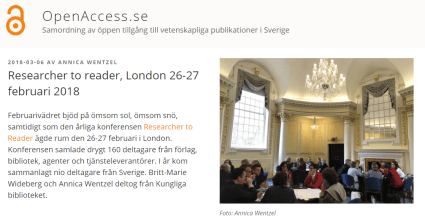
 The first review (that we are ware of) from the 2018 Researcher to Reader Conference has been published, on the National Library of Sweden’s Open Access blog. It is in Swedish, but there is a slightly enhanced automated translation posted below.
http://openaccess.blogg.kb.se/2018/03/06/researcher-to-reader-london-26-27-februari-2018/
Please let us know at info~~~på~~~R2RConf.com of any other reviews out there.
Mark Carden
6 March 2018
The February weather offered a lot of sunshine, and also snow, while the annual Researcher to Reader Conference took place February 26-27 in London. The Conference gathered more than 160 participants from publishers, libraries, agents and service providers. This year, nine participants came from Sweden. Britt-Marie Wideberg and Annica Wentzel attended for the Royal Library.
During the two days of the Conference, three workshop sessions were held on five topics: Open Science Responsibilities, Resilience Through Diversity, Open Data Sharing, Metadata Lifecycles, and Open Access Communications. Annica Wentzel attended the workshop on “Open Access Communications”, which looked at what communication happens when a researcher submits an article when it is reviewed, published and paid. Then you looked at where in the process most problems arose and how they can be solved. The result will be an action plan to improve communication in these steps.
Britt-Marie participated in the workshop on “Open Science Responsibilities”. Opportunities and challenges for the different groups of publishers, libraries and researchers were discussed during the three sessions and the organizers will return with a summary of the group’s results.
The program featured several interesting presentations. A few examples:
Alison Mudditt, PLOS, talked about Changing the Culture of Research – It’s Everyone’s Problem. In order to change the research culture, first and foremost, new, easy-to-use infrastructure must be built.
Ros Pyne from Springer Nature presented the publisher’s report The OA effect. How does Open Access affect the use of scholarly books? The report’s results show that an Open Access book is downloaded more than an average “non-OA” book during the first four years of the book, and seven times more during the first year of the book. The OA book is also cited 50% more than the non-OA book in the first four years. Why that’s so is unclear – is it due to better accessibility, or to a certain type of author or books being read more, is open access published?
Dr. Maria Bonn told us about the University of Illinois project Publishing Without Walls . It has been investigated what authors have for their publishing goals and how they managed to achieve their goals through different ways of publishing their research.
Lucy Lambe talked about the library as a platform for publishing, and her work to enable this at the London School of Economics.
Dr Catherine Cotton, Sally Hardy and Dr Caroline Sutton participated in a panel as representatives of learned societies. They discussed, among other things, how Learned Societies need to work together to meet the challenges of Open Access. They saw some Open Access issues, such as authors in parts of the world who can not afford to pay APCs. Open Access allows research articles to be accessible to everyone – but can everyone understand? Will it cause authors to write two variants of articles, one traditional and one that is easier to understand? The representatives did not see that they could make all their journals Open Access in the near future.
Susan Gibbons of Yale University Library completed the Conference with an interesting presentation, Aligning Library Services with Researcher Needs that involved understanding the needs of users today and adapting the library accordingly.
In summary, there were two contentious days with a lot of focus on open access and curiosity about new ways to publish research articles.

 We are delighted to announce that HighWire will be the Gold Sponsor for the 2019 Researcher to Reader Conference. This is a unique position, as we only invite one organisation to be the Gold Sponsor for each Conference.

 We are very excited to announce the return of
  We are delighted to announce that Dr Marc Schiltz, President of Science Europe and Secretary General & Executive Head of the Luxembourg National Research Fund (FNR), will be a Keynote Speaker at the
  Normally, we run the Researcher to Reader Conference Super Early-Bird rate just in October, switching to the regular Early-Bird rate during November. But this year we have decided to extend the Super Early-Bird
  We are delighted to announce that Mark Allin has joined the Researcher to Reader Conference 2019 Advisory Board.
 Researcher to Reader Conference — London — 24-25 February 2026
You must be logged in to post a comment.