
People ask what is special about the Researcher to Reader Conference, and why someone should register for, and participate in, this event in particular. Here are some of the reasons we believe you should consider.
- Packed with Valuable Content
- About the Whole of Scholarly Communication
- Interactive and Collaborative
- Inclusive and Welcoming
- Highly Regarded
- Excellent Value
- Great Venue
- Well Run
- Acts as a Community
Packed with Valuable Content
The R2R Programme is always packed full of valuable content in a variety of formats. We have sessions that include:
- informative presentations and inspiring keynotes, given by experts in key topics;
- real panel discussions, to explore challenging issues;
- collaborative workshops, to discuss and solve problems;
- formal debates, which require a structured case to be made;
- probing interviews, that get the best out of individual commentators.
We work hard to ensure that all our sessions are of high quality, and that there are no weak links. Experienced moderators and speakers often express surprise at how vigorously we curate the programme and prepare the sessions, compared with other events.
In our breaks the main programming, Conference participants can benefit from conversation with other members of the R2R community, or they can opt to attend any of our Lightning Talks, which we usually also record for later viewing.
Many other conferences are padded out with peripheral activities such as awards, AGMs, vendor sessions and pre-dinner naps, or have days that are only half full, but R2R is busy and useful for the whole two days.
About the Whole of Scholarly Communication
The scope of the Researcher to Reader meeting includes conversations across all of scholarly communications, from the researcher writing something, to the person reading it. We are not ‘just’ a publishing conference, or ‘just’ a library conference, or ‘just’ an open access conference, or ‘just’ a European conference; we explore the whole scholarly communications landscape, internationally, and aim to break down the silos and frictions that impede effective transmission of information from the researcher to the reader.

This makes our meeting more useful, more interesting, more collaborative and more strategic.
Interactive and Collaborative
Our ethos is collaborative communications amongst our community of participants, rather than pearls of wisdom handed down by grandees on the stage to a passive audience. Our round-tables are real conversations (not mini speeches), our plenary sessions have ample opportunity for questions, and our workshops are devoted to truly collaborative problem-solving.

The vast majority of our speakers, panellists, moderators and facilitators participate in the whole Conference, learning from, and bringing their insights to, many other sessions.
All of these interactions within the scheduled programme then help to promote great conversations amongst the Conference participants in the breaks.
Inclusive and Welcoming
R2R is a very inclusive and welcoming event, driven in part by breaking down silos within the scholarly communications landscape, and assisted by our collaborative ethos. Where possible, our seating is in groups at ‘cabaret’ tables (not in ranks of chairs), encouraging conversation amongst those participants who are sharing a table.
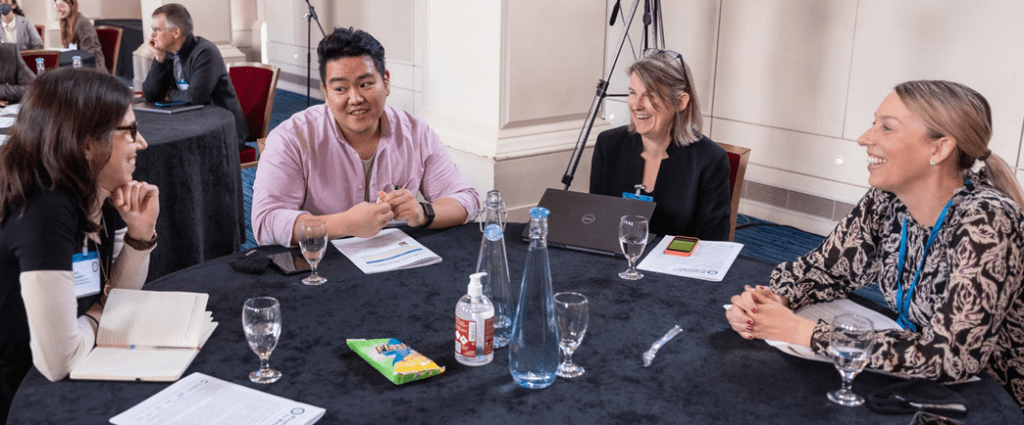
In addition, our workshops make a great contribution toward bringing people into the community discussions, ensuring that every Conference participant has joined a group of 15-30 workshop colleagues on the first morning, with whom they can continue to stay connected throughout the two days, and maybe thereafter.
We feel it is very important to include researchers and editors in the Conference community, to help to better inform the intermediaries (such as funders, publishers, librarians and technology providers) who are working to support them. Academics can be hard to attract to a scholarly communications event, but we try to encourage their participation with our inclusive ethos, favourable ticket rates, and even the name of our meeting. We typically have around 30-50 PhDs participating each year.
While the broad nature of our conversations tends to attract senior and strategic people, including library directors, CEOs and professors, we also make sure to include ‘early career’ people, to make sure our discussions include a range of views and experiences.
We have had people joining the meeting from over 30 countries, and we strive to ensure that we have geographic diversity, so that we can knowledgeably and equitably discuss global scholarly communications.
We also work hard to support registered delegates with particular access or communication needs at the Conference, to ensure that they can participate as fully as possible.
Highly Regarded
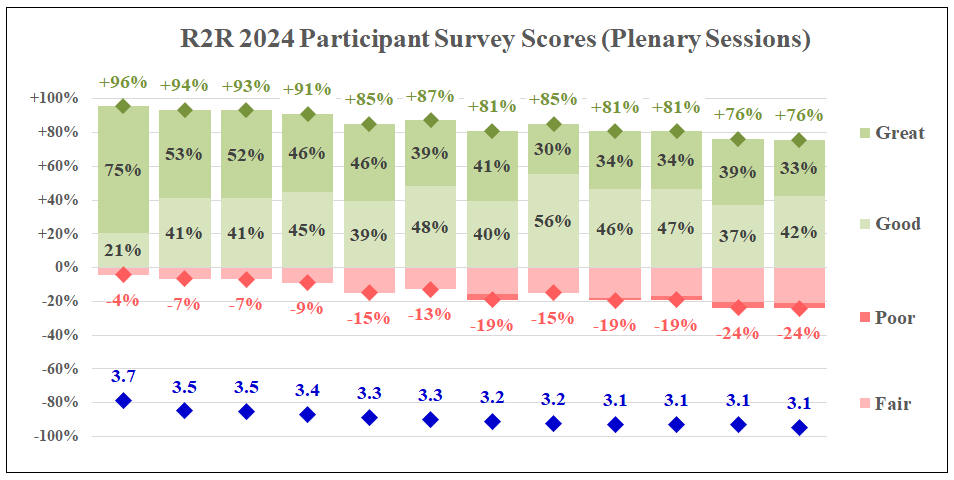
We are told that R2R is highly regarded amongst our participant community, both informally and through our annual participant surveys. We work hard to get high response rates for our surveys (usually around 50-60%), and we study, publish and act on the results.
Through this research and analysis, we know not just which sessions are the most popular, but also whether we are maintaining our high standards across the board, with no weak links. The vast majority of our sessions receive between 80% and 100% positive ratings.

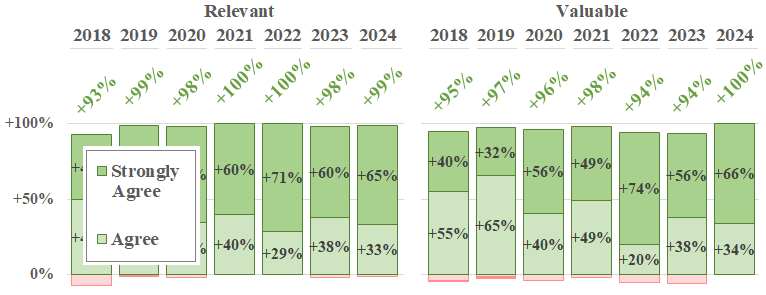
We also know that year-after-year 93-100% of responding participants find the Conference to be relevant to their work and 94-100% find it valuable use of their time.
Excellent Value
Although conferences are generally rather expensive, registration for R2R continues to be comparatively affordable; we monitor the tariffs for multiple events, noting the cost, duration and amount of content, to compare the ‘price per full day of programming’, and we continue to be substantially below almost every equivalent conference, both for the top ‘headline’ tariffs and for discounted options. We generally offer significant discounts for returning participants, librarians, academics and concessions. We are grateful for the financial support of our sponsors, which helps us to keep ticket prices lower.

Combining our relatively low prices with the very full and high-quality programme makes us outstanding value-for-money, as around 80-90% of our survey respondents agree each year.

There is also no risk in registering promptly for the Conference, including taking advantage of any early-bird rate that may be offered, as we have a generous cancellation policy, which allows a full refund for any booking up to the end of January (typically about three weeks before the event).
Great Venue
To date, our physical venue has always been BMA House in central London, which provides us with a great location, a magnificent plenary hall, all the workshop breakout rooms that we need and excellent food.

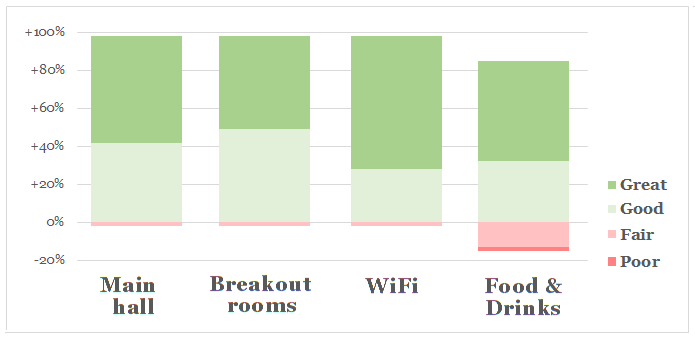
Our participants consistently rate the venue very highly, although pleasing everyone with the menus (and the room temperature) is a constant challenge.
Well Run
R2R has a great reputation for efficient administration and operations, both in the run-up to the event and during the Conference. We work hard to support our participants & speakers, keep to time, and get drinks and food served quickly in the breaks. We also strive to provide an excellent service to our sponsors. Our audio-visual production is generally well regarded, and we received exceptionally positive feedback for our forays into online and hybrid conferencing during the pandemic, keeping our interactive meeting ethos alive, and avoiding a pivot to unappealing broadcast webinars. We consistently get over 90% positive survey responses for our administration, venue and environment, and one year got 100% positive responses for administration, with over 70% rating us ‘Great’.

This is enabled, to a great extent, by the outstanding support we have received from The Events Hub, Giggabox, Eventscase and BMA House.
Acts as a Community
As well as being more of a meeting than a conference, with participants rather than delegates, we are aiming to be more of a community than (just) a conference. This is hard to do, as people are busy, and are a bit reluctant to engage with yet another information channel. But we do feel that we are gradually building a community, with each year’s Conference having a nice balance of around 50% returners and 50% new people.
We are guided by an Advisory Board made up of people from a across the scholarly communications community, who ensure that our ethos ad our programme are relevant to all.
(Updated 22 November 2024 and 24 June 2025)
 Researcher to Reader Conference — London — 24-25 February 2026
You must be logged in to post a comment.