
Conference Programme
The Programme for the 2024 Conference, which took place in London on 20-21 February 2024 is shown below.
Download summary Programme (PDF)
Download simple text Programme (TXT)
TUESDAY 20 FEBRUARY 2024
9.30
Welcome and Introduction
9.45
Keynote
VIDEO (YouTube) – SLIDES (PDF)
- Antonia SEYMOUR
CEO at IOP Publishing and the President of the Publishers Association
10.30
Workshops: First Meeting
Workshop A: Sustainability for Global OA Book Usage
The OA Book Usage Data Trust is working to facilitate the ethical data exchange of open and proprietary usage data about OA books. This workshop invites OA usage stakeholders to learn what the Data Trust IDS service will provide, to then explore and evaluate ways to sustain such a trusted, neutral data intermediary infrastructure within the scholarly publishing ecosystem.
- Christina DRUMMOND
Executive Director of the OA Book Usage Data Trust - Ursula RABAR
Community Manager at the OA Book Usage Data Trust
Workshop B: AI in Scholarly Communication
Artificial intelligence (AI), machine learning and natural language processing are revolutionizing research processes and scholarly communications. There is already impact from AI on authoring, translation, peer review and discovery. How can members of the scholarly communications ecosystem, including librarians and publishers, get to grips with the opportunities and threats presented by AI across the content creation and dissemination lifecycle? What are the priorities and the next steps for supporting responsible AI use and for countering bad practices and misinformation?
- Vivien BENDER
Executive Editor at Springer Nature - Martin DELAHUNTY
Director at Inspiring Stem Consulting - Gwen EVANS
Vice President, Global Library Relations at Elsevier - Professor Lisa HINCHLIFFE
Professor at the University of Illinois - Dr Haseeb IRFANULLAH
Independent consultant on the environment
Workshop C: Publishers and ECRs Working Together
Many initiatives have been launched that aim to empower early career researchers in the publishing ecosystem. Commercial and non-profit/society publishers alike have recognised the importance of engaging with ECRs, but what do they get out of these relationships and what are the benefits for the ECRs themselves? This workshop will explore the perspectives of both publishers and ECRs on existing initiatives, and generate recommendations to guide future plans.
- Dr Rose PENFOLD
PhD Fellow at the University of Edinburgh - Dr Reinier PROSÉE
Preprint Community Manager at The Company of Biologists
Workshop D: Research Data Sharing and Reuse
Data policies mandate researchers to deposit data in repositories, but is this sufficient to improve quality and re-usability? In this workshop, we will invite practising researchers and other data practitioners to test assumptions on data practices, with the goal of developing an action plan to be taken forward by stakeholders in the research data ecosystem. Workshop participants will aim to: understand and articulate current data sharing priorities for researchers, publishers, institutions & funders, discuss each priority & identify barriers for data sharing/reuse, describe required changes and develop an action plan.
- Maria GUERREIRO
Head of Partnership Development at Dryad Data Repository - Dr Fiona MURPHY
Co-founder at MoreBrains Cooperative - Iratxe PUEBLA
Director, Make Data Count, DataCite
Workshop E: Peer Review Innovations
Peer review is a critical part of the research process and a key contributor to research integrity, but dissatisfaction with its equity, effectiveness and economics is encouraging innovation. This workshop will explore how academics, publishers and others can improve peer review with initiatives such as reviewer anonymity and transparency, anti-ghosting policies, post-publication review, early-stage peer review, use of AI and many more, aiming to create greater momentum for improving the effectiveness and value of peer review.
- Tony ALVES
SVP Product Management at HighWire Press - Alice ELLINGHAM
Founder and Director at Editorial Office - Jason DE BOER
Founder and Managing Director at De Boer Consultancy - Lizzie HAY
Associate Director at Editorial Office - Chris LEONARD
Director of Strategy & Innovation at Cactus Communications
11.30
Break, with Lightning Talks
12.15
Achieving and Sustaining Open Access Through Local Initiatives
Disciplinary Open Access: 10 years of SCOAP3
VIDEO (YouTube) – SLIDES (PDF)
In 2024, the Sponsoring Consortium for Open Access Publishing in Particle Physics (SCOAP3) – a global collective action of over 3,000 participating libraries, research institutions and funding agencies – will celebrate a decade of delivering equitable, global, open access for the field of high energy physics. This presentation will describe how SCOAP3 has sustained discipline-wide OA through a spirit of global collaboration, and provide key insights and lessons that can inform future strategies for supporting open access publishing. As SCOAP3 enters its next decade, it will describe how the initiative aims to continue to innovate to shape the future of open access.
- Dr Kamran NAIM
Head of Open Science at the European Organization for Nuclear Research (CERN)
Open access in Latin America: the challenge of a sustainable publishing model
VIDEO (YouTube) – SLIDES (PDF)
Publishing models are being increasingly discussed, especially considering that publishing practices are not equal around the world. There are ongoing discussions on how to implement equitable and sustainable access to scientific content, both for readers and authors. Diamond open access has been widely adopted in Latin America, where the majority of journals are published within public universities, through public funds. But how can these journals sustainably advance their missions and still be competitive, when prevalent evaluation models do not value local journals, and the number of international journals is growing exponentially?
- Dr Ana HEREDIA
Senior Associate at Maverick
1.15
Lunch, with Lightning Talks
2.15
Debate: Academic Libraries Are No Longer Necessary
VIDEO (YouTube)
- Rick ANDERSON
University Librarian at Brigham Young University - Mandy HILL
Managing Director, Academic Publishing at Cambridge University Press - Keith WEBSTER
Dean of Libraries Carnegie Mellon University
3.15
Break, with Lightning Talks
4.00
Translating research into action:
communicating with professionals, policymakers and the public on sustainability
VIDEO (YouTube) – SLIDES (PDF)
Speakers will make the case and review ways to share the practical implications of research outside academia, to equip professionals, policymakers and the public to take action towards meeting the SDGs, including addressing climate change. Hear why it is important for practitioners to communicate research effectively outside of academe; hear a publisher talk about plain language summaries and discuss other resources that are currently available; hear from a technologist about how AI/new technology can make this task easier and more cost effective.
- Chirag (Jay) PATEL
Head of Sales, Americas at Cactus Global - Dr Jo WIXON
Director, External Analysis at Wiley - Dr Roger WORTHINGTON
HESI SDG Publishers Compact Fellow
4.30
Workshops: Second Meeting
5.30-6.30
Drinks Reception (sponsored by SSP)
WEDNESDAY 21 FEBRUARY 2024
9.30
Making New Models For Scholarly Communication a Reality
VIDEO (YouTube)
There is widespread consensus that we need to move to a more open and equitable publishing model. There are also plenty of ideas around about how a new model might work, one of the recent ones being the paper from Plan S: Towards Responsible Publishing. In this proposed future, the output of research is envisaged as being firmly in the hands of the researcher. But what does this mean in practice? And how are we going to make this happen? What are the obstacles and how can we overcome them? This panel will discuss some of these questions from the viewpoint of different stakeholders who are all grappling with what the future might look like and how it impacts how they work now.
- Jayne MARKS (moderator)
Senior Associate at Maverick Publishing Specialists - Roheena ANAND
Executive Director, Global Publishing Development at PLOS - Professor Björn BREMBS
Professur für Neurogenetik at the Universitat Regensberg - Yvonne NOBIS
Head of Physical Sciences Libraries at Cambridge University
10.30
Workshops: Third Meeting
11.30
Break, with Lightning Talks
12.15
Dealing with Research Misconduct in Scholarly Publishing
VIDEO (YouTube) – SLIDES (PDF)
In recent years there has been a sharp increase in the submission of “problem” papers, resulting in questionable research integrity and even over research misconduct. Problem areas include figure plagiarisation and manipulation, tactical citations, ‘tortured phrases’ and purchased authorship. Some of these problems are hard to spot at the submission and review stages, leading to eventual retractions. This presentation will include brief examples of each problem type, and suggest methods to spot such misconduct at submission stage, and ways to deal with false positives.
- Dr Kaveh BAZARGAN
Director at River Valley Technologies
12.45
Navigating the Pressures of Modern Research:
Cultivating an equitable and innovative academic culture
VIDEO (YouTube)
Academia places immense demands on researchers to excel and produce impactful research outcomes. These demands, exacerbated by systemic issues lead to stress and burnout, affecting researchers, particularly non-native English speakers. Survey results reveal that 65% researchers felt tremendous pressure to publish, secure grants and complete projects. 31% work 50 hours+ and 49% have non-research responsibilities. Interdisciplinary collaboration, AI and competitive funding have compounded these issues. The panel brings diverse perspectives on the challenges and transformative measures needed to streamline publication. How can publishers, societies, and researchers alleviate pressure, promote fairness, and prioritize innovation in academia?
- Roheena ANAND (moderator)
Executive Director, PLOS - Dr Rashna BHANDARI
Head, Laboratory of Cell Signalling Centre for DNA Fingerprinting and Diagnostics - Makoto YUASA
Country Director, Japan Cactus Communications - Professor ZHANG Hongliang
Professor at Fudan University
1.40
Lunch, with Lightning Talks
2.40
Transformative Agreements: US University Perspectives
Understanding Reading and Publishing:
Distilling the data that institutions need to manage transformative agreements
VIDEO (YouTube) – SLIDES (PDF)
Transformative agreements, which are based on both reading and publishing, offer new and complex assessment challenges, since in addition to measuring usage relative to cost, we now need to understand publication patterns. Data around authorship, funding, and article type are highly variable yet necessary for determining the impact of transformative agreements. A librarian, a consortium leader and a vendor address multi-dimensional perspectives to the challenges that the industry faces with the dissemination, collection, and analysis of data about authorship, readership, and value.
- Michael LEVINE-CLARK
Dean of Libraries at the University of Denver
Developing a Data Informed OA Strategy:
An analysis of OA publishing data at the University of Kentucky
VIDEO (YouTube) – SLIDES (PDF)
Faced with the expectation that most articles will be published OA in the next several years and with mandates from the National Institutes of Health, Office of Science and Technology Policy and other funders, libraries are implementing collection strategies to support OA. This is leading to an increase in transformative agreements at institutions in the United States, even as cOAlition S in Europe is moving away from these. The University of Kentucky Libraries questions whether transformative agreements are the best option for our institution or if they are just the Big Deal under a new name.
- Ben RAWLINS
Associate Dean for Outreach, Engagement and Collections at the University of Kentucky
3.40
Break
4.15
Workshop Feedback
VIDEO (YouTube) – SLIDES (PDF)
4.50
We Don’t Know What We Don’t Know:
Multi-sector and multi-disciplinary experience to break down barriers
VIDEO (YouTube)
What unexpected insights and opinions about the complexities and interconnectedness of the scholarly communication ecosystem can be gleaned from those who have switched between the sectors of publishing, research, and libraries? What are the common misconceptions about each industry or conversely, what is accurate? Where is nuance and deep knowledge most needed? Panellists will discuss how bringing their multi-sector or multi-disciplinary experience did and can help dismantle some of the silos that hamper effective communication, partnerships, and mutual respect between the major actors and organizations in current and future imbrications.
- Professor Lisa HINCHLIFFE (moderator)
Professor at the University of Illinois - Gwen EVANS
Vice President, Global Library Relations at Elsevier - Keith WEBSTER
Dean of Libraries Carnegie Mellon University - Dr Karin WULF
Director and Librarian at the John Carter Brown Library
5.45
Summary and Closing
VIDEO (YouTube)
- Dr Heather STAINES
Director of Community Engagement at Delta Think
and President-elect of the Society for Scholarly Publishing
Sponsors
Researcher to Reader Conference 2024 Sponsors
Our sponsors provide much-needed financial support for the Researcher to Reader Conference, and for the scholarly communications community, while also increasing awareness of their brands, products and services. Without the generous support of our sponsors, registration cost would be around 50% higher for our delegates.


This year, we are delighted that the Royal Society of Chemistry is once again our Gold Sponsor. As a society publisher dedicated to the chemical science community and a clear commitment to transition to fully Open Access publishing by 2028, the RSC helps researchers around the world make great discoveries and accelerate innovations.


Digital Science is an innovative technology company offering digital solutions across the research ecosystem. In partnership with researchers, universities, funders, industry and publishers, Digital Science works towards advancing global research for the benefit of society. The Digital Science brands – Altmetric, Dimensions, Dimensions Research Integrity, Figshare, ReadCube, Symplectic, IFI CLAIMS Patent Services, Overleaf, Writefull, OntoChem, Scismic and metaphacts – help to solve problems and drive progress for all.
MDPI is a pioneer in scholarly, open access publishing, that has supported academic communities since 1996. Based in Basel, Switzerland, MDPI has the mission to foster open scientific exchange in all forms, across all disciplines. MDPI’s 379 diverse, peer-reviewed, open access journals are supported by more than 115,000 academic experts who support MDPI’s mission, values, and commitment to providing high-quality service for our authors. MDPI’s articles are freely available and distributed under a Creative Commons Attribution License.

Atypon’s Literatum does more than host scholarly content; it empowers partners to further research, amplify their impact, and connect with their communities, providing tools for accessibility, engagement, and revenue growth, all backed by technical expertise, ongoing investments, and a secure, scalable platform.


Ex Ordo is an events-focussed software company specific to scholarly needs, headquartered in Galway, Ireland. Event organisers and association professionals use the platform to plan, manage, and execute physical, online, and hybrid conferences for their communities. Linked into the core abstract management system are tools for programme building, delegate registration, a mobile app, print-ready book of proceedings, an integrated virtual platform to support interactive online events, and more – all backed by dedicated, expert support.

Mosaic Search & Selection has been providing international executive recruitment services for publishers and related organisations for over 20 years. The Mosaic team uses their many years of sector and recruitment experience, and their professional executive search skills, to enable organisations to hire exceptional new talent cost-effectively and with minimal risk.

Silverchair is the leading independent platform partner for scholarly and professional publishers, serving our growing community through flexible technology and unparalleled services. Silverchair builds and hosts websites, online products, and digital libraries for their clients’ content, enabling researchers and professionals to maximize their contributions to our world. Silverchair’s vision is to help publishers thrive, evolve, and fulfill their missions
KnowledgeWorks Global Ltd. (KGL) is the premier industry provider of editorial, peer review, production, management consulting, online hosting, association management, and transformative solutions for every stage of the content lifecycle. KGL unites content and technology expertise with over 200 years of experience serving the publishing market and is powered by intelligent solutions and delivery platforms including Smart Suite and PubFactory.

The Society for Scholarly Publishing (SSP), founded in 1978, is a nonprofit organization formed to promote and advance communication among all sectors of the scholarly publication community through networking, information dissemination, and facilitation of new developments in the field. SSP members represent all aspects of scholarly publishing— including publishers, printers, e-products developers, technical service providers, librarians, and editors.
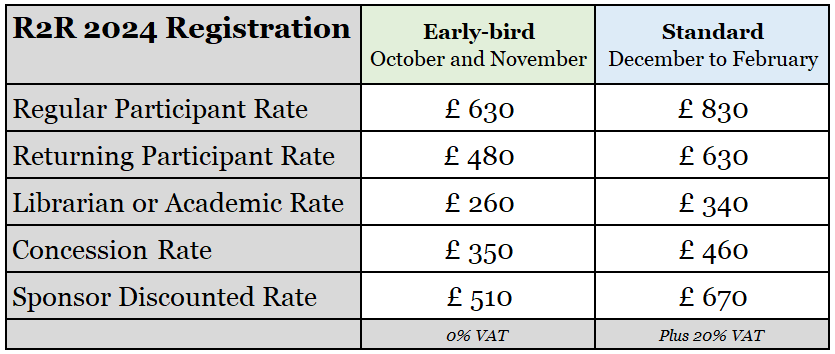
Registration
Feedback
Summary
Participant feedback for the 2024 Researcher to Reader Conference, which took place at BMA House in London on 20-21 February, demonstrated continued high levels of satisfaction with the event, with delegates rating the Conference very positively.
Of those responding to the survey, over 98-100% rated the Conference relevant, valuable and recommendable (up from 94-98% in 2023), with the content overall receiving 94% positive ratings (up from 89%).

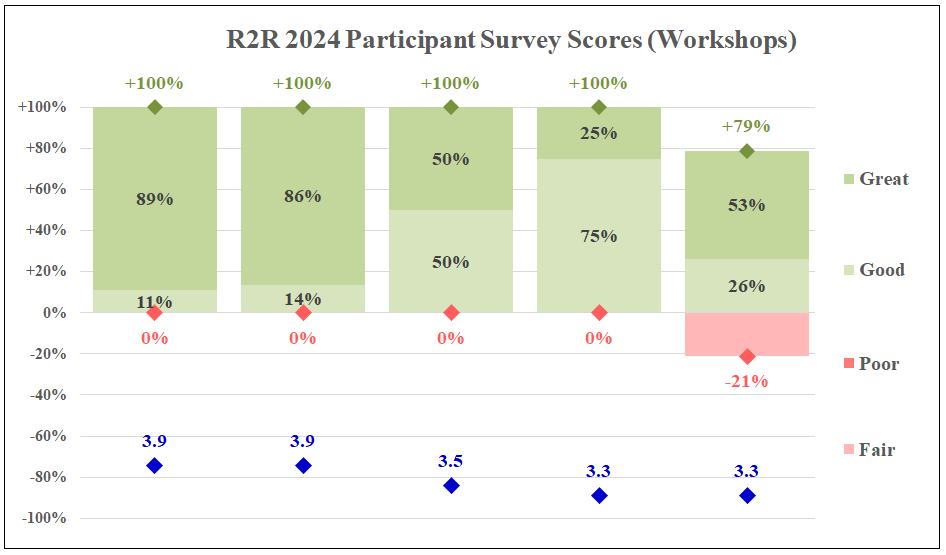
Plenary sessions in the main hall had average scores ranging from 3.1 to 3.7 (out of 4), with an overall average score of 3.3. The lightning talks (offered during the breaks) averaged even better, with the same range, but an average of 3.4 overall. Four out of the five breakout workshops received 100% positive feedback, with the average score for each of the five workshops ranging from 3.3 to 3.9 (out of 4), and an average score overall of 3.6. The structure of the event (timetable, mix of sessions, etc) was positively scored (92%), the food highly regarded (95% positive), and the event administration got 96% positive feedback.
Detailed Report
The survey, completed by over 50% of participants, showed 98% of respondents agreeing that the Conference was relevant to them professionally, and 100% saying it was valuable use of their time. 98% of those responding said they would recommend the event to others – we hope they will do so!

The overall content of the Conference was positively reviewed, with almost all respondents giving very positive scores and comments on the scope, content and delivery of the sessions. A few people suggested we should give more attention to the humanities and to books, and we will definitely aim to improve on this. Including more funder voices was also mentioned, and we would welcome any funders who wanted to join our conversations. We also continue to strive to include more voices from outside Europe and North America, and would welcome ideas and proposals that would help with this.
- “A diverse array of topics, all interesting and valuable”
- “Overall, great content”
- “Excellent mix of high profile speakers”
- “Fantastic speakers”
- “I am impressed how interesting a conference can be”
The plenary sessions at the Conference (including panels, presentations and the debate) received highly positive ratings across the whole timetable. All sessions received an average rating of 3.1 to 3.7 (out of 4). This consistent range of high scores shows that the vigorous curation of the programme is highly effective in ensuring all sessions are of high quality, and are valued by the vast majority of participants. Particularly highly-rated were the opening keynote, the debate, the pair of presentations on transformative agreements, and the closing summary.

The highly interactive workshops were also all positively viewed, receiving an average rating of 3.3 to 3.9 (out of 4). Almost everybody rated their workshop positively, and for two of the five topics on offer, over 85% of the participants rated their workshop ‘Great’. Even in the lowest-scoring workshop, almost 80% of respondents rated it ‘Good’ or ‘Great’. As usual, nobody rated their workshop ‘Poor’.
Some people said that we did not allow enough time for their workshop topic, while others said they wanted to attend multiple shorter workshops, so perhaps we have the balance about right!
The R2R workshops are the most demanding part of our programme, both for the facilitators and the event management, but they are highly rewarding for the participants (and, usually, for the facilitators); we particularly welcome proposals for workshops in our Call for Papers.
- “R2R workshops are always a delight”
- “The workshops facilitated strong interdisciplinary exchange of knowledge and opinions”
- “I thought the workshops were great”
The lightning talk sessions also received generally positive feedback, with average scores ranging from 3.1 to 3.7 (out of 4). The lightning talks are proving to be consistently (and increasingly) popular, even though some are purely commercial presentations.
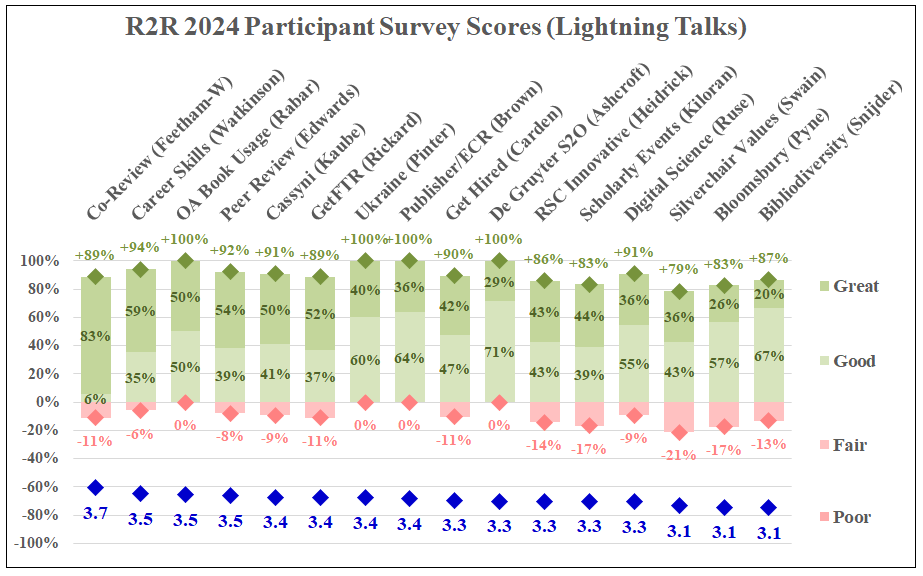
Several people we unhappy that we scheduled the lightning talks during the breaks, but we want to keep commercial presentations optional for the delegates, and it is hard to see how we could integrate about 90 minutes of this material into the main programme. Video recordings of the lighting talks were made available soon after the Conference, so that people who wanted to focus on conversations with fellow participants on the day didn’t have to miss out on this content.
The overall format and timetable for the Conference was, however, positively reviewed by over 90% of respondents. We pack a lot into two days, and some people say that they find the timetable a bit intense (“It was a little bit too busy and full on”), but others seemed to like the energy this generates (“Fast paced, always something happening”). We will try to add a few extra breathing-spaces into the programme in future, while somehow keeping all the content!

The overall dates and duration for the event received 97% positive responses, with people generally liking the format of two full days, although there were some calls for an earlier start and finish on the second day (which was a bit late this year). A couple of people suggested some sort of pre-Conference on the Monday, and we will have a think about whether that might be desirable and manageable one day.
- “Appreciate the plenary structure, and that you cram so much into two days”
- “Good balance of formats (and breaks)”
- “I liked the mix of standalone speakers and panels in the plenaries”
- “Two days is the exactly right length”
- “Liked the concentrated format”
- “February is the perfect time for a conference”
We were also pleased (and relieved) to see that 86% of participants feel that the R2R Conference is good value for money. Events are continuing to get more expensive to deliver, as the cost of venues, catering and other aspects rise, but we try to keep ticket prices affordable, helped by the support from our sponsors.

The event administration, managed by The Events Hub, got 96% positive scores, the same as for 2023, with many very positive comments. There were also positive reactions to our Registration process (96%) and to our Marketing messages (81%) although a couple of people mentioned minor registration problems, or over-long marketing emails, and we will keep an eye on this.
- “Very easy to register online”
- “There were the right number of reminders to register”
- “Promotion of R2R is good”
- “Amazing staff”
- “A great team”
The Conference venue (BMA House) got many positive comments during the event, and the catering received 95% positive ratings in the feedback survey, although a couple of people found the food too ‘experimental’ or ‘spicy’, and some said the coffee was cold. We are glad that our participants share our satisfaction with the venue.
- “Food was great”
- “Some of the best conference food I’ve had”
- “The food is noticeably better than the typical conference food”
- “The lunches were really tasty”
R2R works hard to host a very inclusive event within the scholarly communications community, and this includes the breadth of our scope, the diversity of our participants and the collaborative ethos that we try to maintain during the meeting. Encouragingly, there were many positive comments in the survey responses about this, including:
- “Good mix of viewpoints, perspectives, and topics”
- “The overall ‘vibe’ was friendly and open”
- “Compared to other conferences, this feels much more collegiate and collaborative”
- “A friendly atmosphere, with a good mix of new and returning delegates”
- “Very relaxed and friendly”
Overall the survey results, and other feedback, suggest that the 2024 Researcher to Reader Conference was useful, enjoyable and good value for the overwhelming majority of participants. We are continuing to review all the feedback carefully to see what improvements can be made in future, to ensure that we keep up this very positive reputation.
 Researcher to Reader Conference — London — 24-25 February 2026
You must be logged in to post a comment.